Chapter 1: The Day I Realized Life Had Become Too Easy
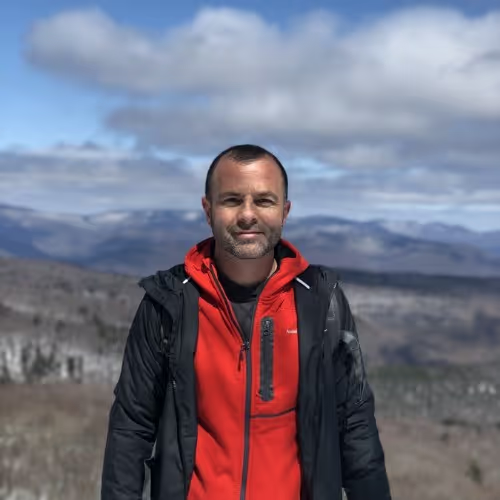
The moment the argument stopped being theoretical. Thirty-five miles still to go, every rational case for stopping already made, and still moving.
TL;DR
December 2024. By every external measure, the author was succeeding. Internally, he was being eroded by sustained cognitive dissonance: speaking up less, accepting compromise, becoming a diminished version of himself. The fix wasn't a reframe or retreat. It was a deliberately chosen ordeal: 240 miles through the Utah desert.
Key Takeaways
Diminishment happens in increments too small to name. You don't fail; you shrink, walls built around you by reasonable-seeming compromises.
The Invisible Ultra of relentless cognitive load is real, but it's a Grind, not a Quest. A Grind has no finish line. A Quest does.
Vision Quests are biologically wired into humans. Choose the boundary, the purpose, and the endpoint.
Toughness is infrastructure, not virtue. Restoration begins by remembering what you were built for.
The 'oh sh*t' feeling after committing isn't a warning. It's a signal that the choice was real.
TL;DR
December 2024. By every external measure, the author was succeeding. Internally, he was being eroded by sustained cognitive dissonance — speaking up less, accepting compromise, becoming a diminished version of himself. The fix wasn't a reframe or retreat. It was a deliberately chosen ordeal: 240 miles through the Utah desert.
KEY TAKEAWAYS
Diminishment happens in increments too small to name. You don't fail; you shrink, walls built around you by reasonable-seeming compromises.
The Invisible Ultra of relentless cognitive load is real, but it's a Grind, not a Quest. A Grind has no finish line. A Quest does.
Vision Quests are biologically wired into humans. Choose the boundary, the purpose, and the endpoint.
Toughness is infrastructure, not virtue. Restoration begins by remembering what you were built for.
The 'oh sh*t' feeling after committing isn't a warning. It's a signal that the choice was real.
Figure 1.1: Mile 205
The moment the argument stopped being theoretical. Thirty-five miles still to go, every rational case for stopping already made, and still moving.
The photograph above was taken at mile 205 of the Moab 240, a 240-mile footrace through the Utah desert. This is a portrait of a man who has finally stopped negotiating. I 'selfied' because something had landed in me with the force of a body punch. It didn't just ripple through my DNA; it rewrote it. I knew, standing in the dirt, that I needed to remember this exact feeling for the rest of my life.
I had just been through hell. I had endured sleep deprivation that blurred the line between reality and dreaming. I had navigated hallucinations, violent storms, profound isolation, and searing pain, running for three and a half days to that section. Yet, in the mountains, which felt like home at that point, I realized it hadn't broken me. On the contrary, I felt hardened. I was changed in every cell.
Moab 240 was my chosen vision quest in 2025. Standing there, with 35 miles still to go, I knew not only that I would finish, but that I was finally ready inside for what I had planned next.
But to understand why a 56-year-old man would voluntarily drag himself through 240 miles of desert purgatory, you have to understand the man I was ten months before that photo was taken.
Too Easy
December 2024. On paper, I was a man who had made it.
I work as a Venture Builder. My entire adult life has been dedicated to taking on difficult startup challenges and winning them. I built my first business in Coventry, England, worked in advertising agencies and media owners for a decade, built an outdoor advertising company on venture capital, moved to the US with the Wall Street Journal, fixed and sold the New York Institute of Finance, and eventually ran the US office of a major UK venture builder from the sun and comfort of Florida.
I was the person you called when the portfolio company was bleeding. "Hard things are fixed through hard work". I meant it. I lived by it.
But somewhere, without noticing, I had stopped being hard on myself.
I was accepting working practices that sandpapered my integrity. Not all at once, but a slow abrasion now and then. I disagreed with leadership approaches not because they were objectively wrong, but because they were wrong for the person I believed I was. Every morning I faced the same two options: speak up, cause the friction and risk the comfort, or stay quiet and keep the check. As time passed, I spoke up less, and I chose the check. I told myself this was collaborative. Sensible. Prudent.
I was living in high-functioning cognitive dissonance. And it was eating me from the inside.
The problem with shrinking is that it happens in increments too small to name. You don't step into a smaller room. You build it around yourself, wall by wall, each compromise so reasonable at the time that you don't notice the ceiling coming down. I wasn't failing. I was succeeding by every external measure while becoming a progressively diminished version of the person those successes were supposed to be for.
Where I once saw patterns and built strategy from them, I now heard noise. My judgment, the one thing I had always trusted, was blunted. Not broken. Blunted. And a blunted tool is more dangerous than a broken one, because you keep reaching for it.
The Invisible Ultra
Sidebar: An 'ultra-marathon' is anything over 50K and can go up to 500 miles, though 100 miles is the sweet spot. It's typically set in nature, in difficult but beautiful environments, mountains or deserts mostly. Running one takes 6–9 months of training, and completion rates average 60%. Beauty and pain, all wrapped up for you.
Before we go further, I need to address something directly.
When I say my life had become "too easy," I mean the loss of productive friction, the seductive comfort of a life where nothing demands the full measure of you. That is one kind of problem.
But I know that for many of the leaders reading this, particularly those carrying the invisible weight of high-stakes careers alongside the domestic management that still falls disproportionately on women, that life does not feel easy. It feels relentless.
My daughter told me this when I described the book's premise. She said that for many people she knows, the idea of "seeking hardship" sounds elitist. Their daily existence is already an endurance sport. She was right to say it. And I needed to hear it.
I call this the Invisible Ultra. It is the unrelenting cognitive load of managing teams, raising children, holding domestic chaos together, and performing the emotional labor that makes everyone else's functioning possible. That is genuinely hard. Don't let anyone tell you otherwise.
But there is a critical distinction, one that this entire book rests on, between a Grind and a Quest.
The Invisible Ultra is a grind. It is unstructured, unending, and unappreciated pressure. It has no finish line. It does not build you. It depletes you, mile by mile, until there is nothing left to give and no sense of self separate from the giving.
A Vision Quest is the opposite. You are biologically wired for it. It is a hardship you choose, with a boundary around it, a purpose within it, and an endpoint you can see from the beginning. It does not add weight to your pack. It teaches you what you are actually carrying, and what you can set down.
We all need a finish line. Not because crossing it proves something to others. Because it proves something to you.
The Decision
There is a physical sensation to long-term cognitive dissonance that nobody warns you about. It is not dramatic. It does not announce itself. It is more like the quiet erosion of a riverbank, gradual, imperceptible, until one morning you step where solid ground used to be and find nothing. I had felt it for months before I could name it. I had been a sharp thinker. Decisive. Pattern-reading. And then, slowly, I wasn't.
You have to understand where I come from to understand what this cost me.
I was an amateur boxer. A street kid from a working-class neighborhood in Coventry, England. A place where you ordered your Christmas gifts from the local shoplifter and learned quickly to give no quarter or be walked over. Toughness was not a virtue there. It was infrastructure.
But I was a contradiction. I was a 'chav' (trailer trash is the US equivalent) who got out through books. I have been addicted to them my entire life. Mining them for ideas, methods, openings, edges. I read the way I boxed: looking for the angle, searching for the thing I could use. The Count of Monte Cristo. Mathematics. Whatever I could get my hands on.
On a Saturday morning run in December 2024, those two sides of me, the fighter and the reader, collided at exactly the right moment. I had been deep in the literature on vision quests and rites of passage. Ancient cultures. Structured hardship to reset identity. Something I had read before, but suddenly it landed differently. If entire civilizations had used deliberate ordeals to restore their people's power, to push them through the threshold, and bring them back changed, I could do the same. On my terms. In my time.
The goal was exact: toughen myself, reclaim my identity, restore the instrument.
I got back to my desk, sweat cooling, and signed up for the Moab 240.
I hit Submit. I smiled. And then, immediately: oh sh*t.
The weight of it arrived fast. Two hundred and forty miles through the Utah desert. Four days. Brutal heat. Relentless elevation. I had raced shorter distances, 50 miles, 100 miles, and I was slow. I had missed timing cut-offs. I had failed and failed again. I struggled with the heat. I struggled with altitude.
So naturally, I had chosen a race defined by heat and altitude. A gauntlet thrown at myself. Prove to me that the chav from Coventry is still in there. Show me the kid who picked a fight on his first day of school and went home that evening to read.
The "oh sh*t" feeling is not a warning. It is a signal. It means the choice was real.
The Hard Fix
We have built a world of frictionless surfaces. We are never disconnected, never unstimulated, never asked to exert ourselves against anything that doesn't have an off switch. We tolerate, at work, things that contradict what we believe, because tolerance is the path of least resistance. It makes us smaller by degrees. Not weak. Diminished. There is a difference. Weaknesses can be addressed. A diminished person does not always know what has been lost.
Over-digitization, sustained cognitive dissonance, and repeated capitulation to the easier road had made a mess of my interior life. I needed a hard fix. Not a reframe. Not a retreat. A hard fix.
My vision quest took six months of preparation. The event itself was four days of sustained physical and mental brutality through the Utah desert. Many entrants did not finish. I did. Look at the photo at Mile 205. That is not the same person who hit Submit in December.
I am not asking you to run 240 miles. I am asking you to understand what deliberately chosen hardship did to me, and to consider what it might do for you. Not as punishment. Not as endurance tourism. As restoration.
But first, we need to change something more fundamental: how you think about the words “easy and hard", as everything that follows will require a different relationship with both.
And it should feel uncomfortable. That discomfort is information. It means you're still capable of being changed.
All proceeds from Hard: Building Your Inner Citadel are donated to registered children's charities supporting young people, including Baby Zone and New Yorkers for Children.
Co-founder, Root Astro · Author, Hard · Four-time CEO
The Fieldstone Letter
Hard is being serialized chapter by chapter, free to subscribers. Each new chapter arrives as it is released, and all proceeds from the book go to children's charities.