The Blue Dot
There is a small blue circle on your phone that tells you exactly where you are at all times. It pulses gently, reassuringly. You are here. Turn left in 300 feet. You have arrived.
It is also slowly atrophying a cognitive faculty that your species spent two hundred thousand years developing. The ability to orient yourself in space without external validation. To read terrain, to sense direction, to build a mental model of where you are in relation to where you need to be.
This is not a metaphor reaching for effect. It is a measurable thing happening inside your skull. In 2020, Louisa Dahmani and Véronique Bohbot studied fifty regular drivers and found that the people with the most lifetime GPS use had the worst spatial memory when asked to navigate without it. They then retested a group three years later. The more someone had leaned on GPS in the interim, the steeper the decline in the hippocampus-dependent memory that lets a human being hold a place in their head. The faculty does not announce its own erosion. It simply gets quieter, until the day you need it and find it gone.
The hippocampus rewards use the way a muscle does. Eleanor Maguire’s work on London taxi drivers showed the inverse of the GPS finding: the men who spent years memorizing twenty-five thousand streets to pass the Knowledge grew measurably more grey matter in the posterior hippocampus, and the volume kept growing the longer they drove. The brain builds the thing you ask it to build. It also quietly dismantles the thing you stop asking for.
The Parallel
Consider how many leaders navigate their organizations the same way they navigate their commute. Dashboard to dashboard. Metric to metric. KPI to KPI. Always knowing exactly where they are in quantitative space, never developing the instinct for where they are in strategic space.
The dashboard tells you your churn rate increased 2.3% this quarter. It does not tell you that your best people are quietly updating their LinkedIn profiles because something in the culture shifted six months ago that no metric captured. That is terrain reading. That is navigation without GPS.
Aviation learned the cost of this before we did. Raja Parasuraman spent a career documenting what he named automation-induced complacency: the operator who trusts the system so completely that he stops monitoring it, loses the picture, and cannot retake control when the system fails. The Royal Aeronautical Society reached the same blunt conclusion studying modern cockpit losses. The wizardry was masking a de-skilling. The instruments were sharp and the hands had gone soft. When the automation handed control back, in the seconds that mattered, there was no longer anyone in the seat who knew how to fly the aircraft. The numbers were never the danger. The dependence was.
What the Desert Taught Me
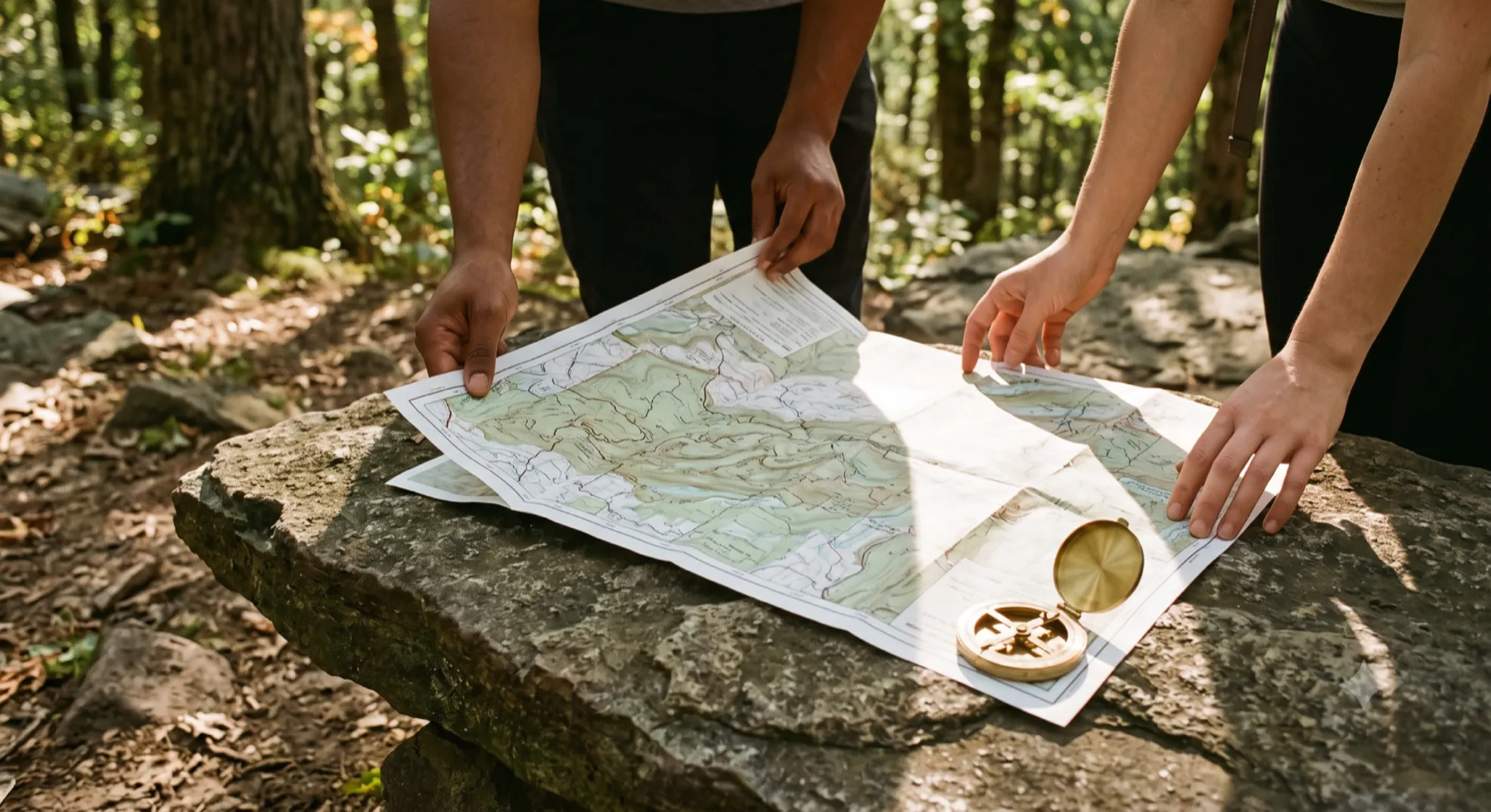
I learned this the hard way, climbing Geyser Pass in the Moab 240 in a freak storm. It rendered our GPS route watches useless for five hours. By then I had been moving through the Utah desert for the better part of three days. The race hands you a route, and there are markers and your GPS watch guides you turn by turn, but somewhere past the point where sleep deprivation stops being a number and becomes the weather you live inside, the technology stop doing the work for you. You can stare at the next reflective tag and still have no idea whether the ground between here and there is a runnable wash or a slope that will take an hour to descend. The faculty that has to answer that question is not in the course notes. It is in you, or it isn't.
What I remember most clearly is the moment I stopped hoping the GPS would return and instead used my sense. I had stopped asking how far to the next checkpoint. I was reading the land instead: the angle of the light off a ridge, the sound of other runners, the difference between the section I was in, and the one a quarter mile east that looked identical on the map and would have cost me half a night. Nobody taught me to do that in the moment. The desert simply removed every easier option until the older faculty woke up.
That state does not arrive comfortably. For the first stretch the uncertainty is exhausting, a low constant hum of am-I-going-the-right-way that burns more energy than the running. Then something settles. The hum quiets into attention. You start trusting the small confirmations: that landmark matches, that bearing holds, this is the right way. The confidence is not borrowed from a screen. It is built, one confirmed read at a time, and it holds weight precisely because you built it.
What Returns
The faculty was never gone. It was waiting to be asked. And the unsettling part, the part I did not expect, is how quickly it returned once the technology failed. Two hundred miles in I was navigating better than I had in years of clean trails and confident phones, not because I had learned anything new, but because I had finally stopped outsourcing the question.
I think the leaders who would struggle most with a compass are the ones who run the cleanest dashboards. They have spent years being told precisely where they are, and somewhere in those years they stopped building the internal map. The map does not teach them anything they did not once know. It returns something they had quietly surrendered, one turn-by-turn instruction at a time.
The map is not the territory. The dashboard is not the business. The leaders who understand this, who can feel the terrain beneath the metrics, are the ones who see what is coming before the numbers confirm it.
You do not lose the ability to find your own way all at once. You lose it the same way you acquired the dependence: gradually, conveniently, one reassuring blue dot at a time.