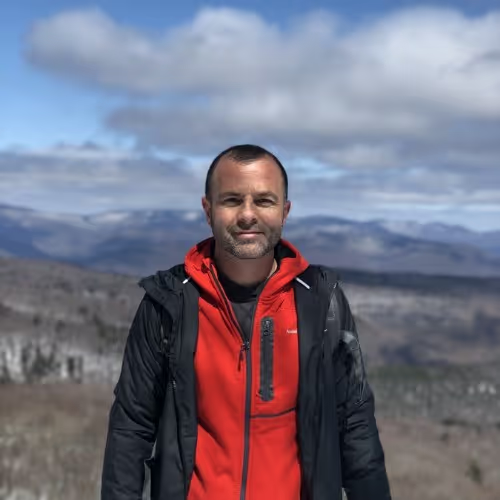
I often looked at my mother with surprise, wonder, and something close to astonishment.
A small woman, thin, barely five-foot-three, but fiery and courageous beyond her size. She would square up to my father, an ex-professional boxer, with whatever kitchen equipment was at hand, depending on his latest transgression. In The New Star, our family pub in Coventry, the rowdiest patrons weren't afraid of the heavyweight behind the bar. They were terrified of the pocket rocket patrolling the floor.
Figure 5.1: Post-Fight, 1972
My father, my mother, my sister, and I after his first British Title fight.
The lesson: looking tough and being tough are different things.
Her presence wasn't a bluff. It was a biological reality. She was the angel to those who needed her, and she was the fire to those who threatened the peace. She could be both, completely, because she wasn't afraid of either. She occupied a space that was already won, because she had built a fortress within: one where her character was the only currency that mattered.
Years later, when I began reading about resilience and came across the Stoic concept of the Inner Citadel, the image that immediately came to mind was not of Marcus Aurelius. It was my mother standing in that Coventry pub. The Inner Citadel, as Aurelius used it, describes a spiritual fortress within the mind: a place of absolute inner authority that no external adversity can reach. My mother hadn't read the Stoics. She had lived them.
Leadership is the art of maintaining your Inner Citadel so that you can be the fire when justice demands it, and the angel when your people need it.
Most modern leaders are porous. Every email, every market dip, every snarky comment leaks into their system and poisons their judgment. They lead from the amygdala, in a state of chronic fight-or-flight. But a leader who has built their Inner Citadel leads with what appears an unfazed smile: the calm at the center of the storm that comes not from the absence of pressure, but from having banked enough stress to know that the daily friction of business barely registers.
The Stoics believed the Citadel was built through philosophy, reflection, and being at one with nature. My experience in the boardroom and on the trail taught me something they didn't publish: you cannot build a stone fortress on a foundation of sand. To truly own your Inner Citadel, you have to upgrade the biology beneath it.
The Source Code Rewrite
For thousands of years, humans have intuitively understood something that modern biology is only now able to measure: if you want to change the spirit, you must first challenge the body.
The Lakota and Anishinaabe people are Indigenous Americans with roots in the Great Lakes, deeply and spiritually connected to the land. They remain in the US today, fierce protectors of their sovereignty and recognized as domestic dependent nations. They practiced the Hanbleceya, "crying for a vision." A young man is sent into the wilderness for four days without food or water, isolated on a mountain ledge or in a pit. The goal is to strip away the comforts of the village and force a confrontation with the self. We have tended to view these rites as purely spiritual. But what they are engineering, without the language for it, is epigenetic change.
Think of your DNA not as a fixed stone tablet, but as a vast library of instruction manuals. In a comfortable modern life, most of those manuals are sealed shut. Your body never needs them, so it never opens them. A 240-mile journey through sleep deprivation, hallucination, and physical breakdown is a cellular emergency signal. It informs the system that the standard operating procedures used to run a board meeting or manage a portfolio are insufficient for the demands now being made.
So the body initiates DNA methylation. It chemically tags specific genes and forces open those sealed manuals. Studies on ultra-endurance athletes show that after extreme exertion, the body rapidly alters the genes governing inflammation, metabolic efficiency, and cellular repair. You are forcing access to a survival mode that a sedentary life will never unlock. And crucially, once those genes are switched on, they do not immediately switch off. You return to your daily life running on an upgraded operating system.
The Biological Inner Citadel
While the cells are updating their software, the brain is upgrading its hardware.
There is a specific moment in every vision quest. The reasons you started, dissolve. For me it arrived at mile 140 of the Moab, day three. The ego goes quiet. All that remains is a raw, pressurised desire to stop. Neuroscience has located precisely where that battle takes place.
It is a small structure called the Anterior Midcingulate Cortex (aMCC). Dr. Andrew Huberman describes this region “as the seat of the will to live”. More precisely: it is the physical location in the brain of doing what you do not want to do. In people who consistently choose the path of least resistance, this structure atrophies. In the leader who takes the difficult call, manages the underperforming colleague, runs the extra mile, it thickens.
You are physically growing the hardware required for tenacity.
The aMCC has neuroplasticity. Every time you move toward friction when everything in you wants to move away, you are performing high-repetition strength training for this specific structure. Post-mortem and MRI scans of SuperAgers, people in their eighties with the cognitive sharpness of twenty-five-year-olds, consistently show a thick, robust aMCC. This is why the eighty-year-old chairman often has more fight in him than the thirty-year-old associate: not wisdom, not experience, but decades of deliberate friction. Heavy-repetition weightlifting for the will, while the culture around them trained people to seek comfort.
When you say you are hard-headed, you are not speaking in metaphor. You have built a physical infrastructure of tenacity that outlasts the race.
Hormesis and the Noise Floor
There is a paradox at the center of stress. Chronic, low-grade stress, the kind produced by a difficult boss, a fractured inbox, or daily ambient anxiety, shortens lifespan. This kind of stress accelerates deterioration. It literally wears the body down biologically.
But acute, voluntary, massive stress does the opposite. This is hormesis: a controlled dose of what would normally be harmful becomes the mechanism of repair.
By surviving the Moab 240, I recalibrated my body's threat-detection system to a level no amount of office stress management could reach. My nervous system now understands what genuine danger feels like: the cold, the dark, running on broken feet, unable to eat without vomiting. Consequently, the code-red alarms of daily business life get downgraded. Not through attitude or discipline. Through biological data.
When I returned to work, the change was immediate and specific. An unexpected financial hit, a difficult personnel situation, a client crisis at six in the evening: my body no longer dumps cortisol into the bloodstream. The noise floor has dropped. What used to constitute a crisis now barely registers, because my nervous system has a new reference point for what crisis actually is.
Most leaders are porous, leaking energy into every obstacle that crosses their path. By voluntarily facing the abyss, you become dense. You raise the threshold of what constitutes a crisis so high that the daily friction of business barely registers.
Endurance athletes typically carry a biological age that is 10 to 15 years younger than their chronological age. This is not a side effect of the training. It is the result of deliberate stress, applied with intention and survived.
The mechanism is measurable. Telomeres are the protective caps on chromosomes that prevent them from fraying: the shoelace cap of your genetic material. Under chronic passive stress, they shorten. Under acute voluntary stress followed by recovery, they hold. Elizabeth Blackburn won the Nobel Prize for demonstrating this. The biology of what you choose to endure is not the same as the biology of what you are forced to absorb.
Going into Moab at 55, my measured biological age was 31. It has since moved to 39 as my training load has lightened. I include these numbers not to impress you. I include them because the gap between what the calendar says and what the cells say is the physical record of every hard thing I chose.
Worried to death is a well-known phrase. It's real. The ambient anxiety of the office ages us. Chosen stress, practiced and controlled, pays back the debt.
The Protocol of the Wild
When the modern executive hears "vision quest," they picture crystals and mild discomfort in a comfortable tent. This is a sanitization of history. Historically, a vision quest was not a retreat. It was a calculated brush with death, designed to ensure that the boy who entered did not come back, and the man who returned was someone the tribe could trust with its survival.
What is remarkable, looking at these rites across cultures with no connection to one another, is how consistent the architecture is. Geography, language, and mythology differed. The core mechanism did not.
Figure 5.2: Vision Quest Examples
The ordeal does not have a fixed form.
What it requires is fixed: that it costs enough to matter, and that you finish it.
| Tradition | Culture | Core Mechanism |
|---|
| Crypteia | Sparta, Greece | Youth sent into the wild with nothing but a knife. Radical self-reliance; all status and tools stripped away. |
| Hanbleceya | Lakota, US | "Crying for a Vision." The Seeker was left in a pit or on a cliff edge without food or water for four days. Confronting the terrifying silence of the ego. |
| Yamabushi Shugendo | Japan | Mountain monks hanging over cliff edges, standing under freezing waterfalls. Ending the chatterbox ego through extreme physical shock. |
| Walkabout | Aboriginal Australian | Months-long rite of separation, navigating the vast outback via Songlines. Transitioning from theoretical knowledge to visceral self-reliance. |
| Moran | Maasai, Kenya & Tanzania | Transition to warrior status required stalking a lion with only a spear. Overcoming the primal fear of death to serve the community as a protector. |
Every one of these traditions was built on the same principle: the social mask has to die before the leader can be born. The comfortable identity, the one that knows where it stands in the hierarchy and what its status is, cannot survive the ordeal intact. That is not a flaw in the design. It is the design.
The Architecture of the Quest
Regardless of geography, every vision quest follows the same three-part structure that Joseph Campbell identified across the world's mythologies. If your challenge does not hit all three, it is not a quest. It is a holiday.
1. Separation
You must leave the known world. You cannot quest in your living room. The cord to ordinary life must be genuinely severed, not just loosened. In a leadership context, this means killing the pings. You cannot find your center while you are tethered to the inbox. Separation also proves something essential: that the organization can survive your temporary absence. That proof matters. It is the first crack in the illusion that you are indispensable.
2. Ordeal (Liminality)
You enter the unknown. You face hunger, cold, fatigue, fear, or all of them. This is where the social mask begins to dissolve, not through reflection but through depletion. As glucose reserves fall and the Default Mode Network, the chatterbox ego that worries about status and emails, begins to power down, the brain enters hypofrontality. The biological door to genuine insight. You cannot think your way to a vision. You have to exhaust the body to free the mind.
For me, that moment arrived on day three, not as a revelation exactly, but as a kind of cellular clarity. My world condensed to a single understanding: the act of turning on a tap and having clean water come out is all I need. Everything else is surplus. That knowledge did not arrive as a thought. It arrived as a physical fact, felt in the body at a level that has not left me since.
3. Return
You come back. But you are not the same person who left, and that is the whole point. The Return is the most dangerous phase for leaders, because it is where most of the value is lost. If you walk back through the office door and resume the old habits within forty-eight hours, the quest was expensive time off. Nothing more.
The Return is about translation: taking the clarity you earned in the desert and using it to rebuild the inner architecture of how you lead. You return as the angel who provides safety, because you have now mastered the fire. You know what you are capable of under pressure because you have been under pressure that has no floor.
The Hard Call
The Inner Citadel is a construction project. Most people spend their lives decorating the outside of their houses while the foundations are made of sand.
I did not pick the Moab because I was good at it. I picked it because I was certain it would break the person I thought I was. If you only quest in areas where you are already strong, you are not building a Citadel. You are redecorating a room you already own.
Find the thing that makes your stomach turn. The one that feels beyond you. Go into that discomfort and stay until the ego falls and the Citadel rises. That is not a metaphor. It is the oldest instruction manual in human history, and it has been road-tested across every culture that ever built something worth keeping.
You have to select something that scares you and feels beyond you. To break ground so you can be rebuilt.
Chapter Tool: The Citadel Audit
Three questions. Answer them honestly before moving to the next chapter.
Figure 5.3: The Citadel Audit
Before you can rebuild, you need an honest account of what has eroded.
Use this to find out where you actually are.
| The Lintel | Who is the 'Pocket Rocket' in your life? What hard thing forged their Inner Citadel? |
| The Leak | Where is your Citadel wall currently crumbling? Is it digital noise, a lack of physical evidence of your own strength, or something else? |
| The Descent | Are you ready to stop decorating the rooms you own and start breaking ground on a foundation that doesn't move? |
Figure 5.4: Your Inner Citadel
Not a metaphor. A structure you build, deliberately, through the accumulation of hard choices made and kept.
Further Resources & References
Anterior Midcingulate Cortex (aMCC): Dr. Andrew Huberman and David Goggins discuss the aMCC and the neuroscience of building willpower. YouTube, Huberman Lab.
Epigenetics and endurance: DNA methylation studies in ultra-endurance athletes reveal rapid changes in gene expression governing inflammation, metabolism, and cellular repair.
Telomere research: Elizabeth Blackburn and Elissa Epel, The Telomere Effect: A Revolutionary Approach to Living Younger, Healthier, Longer.
Vision Quest tradition: David Courchene on Vision Quests. YouTube: https://www.youtube.com/watch?v=SjWquvl6KvY
Joseph Campbell (1904-1987): The Hero with a Thousand Faces. Comparative mythologist who formalized the three-part hero's journey structure (departure, initiation, return).
Arnold van Gennep (1873-1957): coined 'rites of passage.' His three-part ritual structure (separation, transition, incorporation) underpins Campbell's framework.
Inner Citadel: Stoic concept, central to Marcus Aurelius's Meditations. The internal fortress of the mind that no external adversity can penetrate.
All proceeds from Hard: Building Your Inner Citadel are donated to registered children's charities supporting young people, including Baby Zone and New Yorkers for Children.
Buy the book on Amazon →